
Occupational Health and Safety
Occupational Health and Safety
We are committed to providing a safe and healthy working environment by equipping our people with the necessary knowledge, tools, and support to perform their roles safely and confidently.
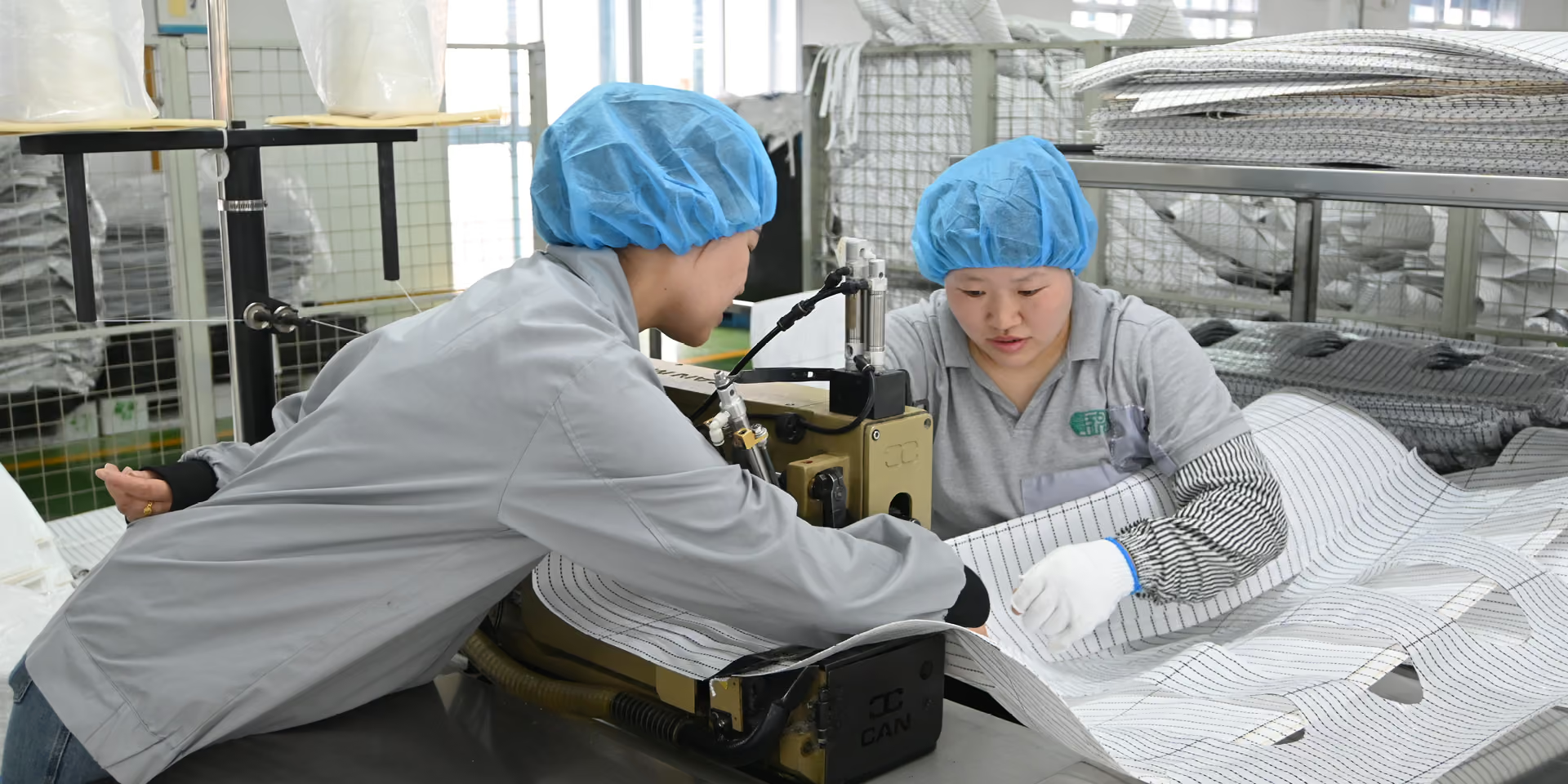
At FPS, safeguarding the health, safety, and well-being of our 3,803 colleagues is a fundamental priority. We are committed to providing a safe and healthy working environment by equipping our people with the necessary knowledge, tools, and support to perform their roles safely and confidently.
Our Occupational Health and Safety (OHS) Management System is designed to proactively identify, assess, and mitigate workplace risks, while fostering a strong safety culture based on awareness, shared responsibility, and continuous improvement.
The system applies to all FPS colleagues and subcontractors across our operations and is aligned with applicable regulatory and international standards.
FPS has achieved ISO 45001 certification at eight facilities located in China, Vietnam, Romania, and Ukraine, covering 53% of our total workforce. This certification reflects our commitment to high safety standards and a structured, preventive approach to Occupational Health and Safety. In line with the ISO 45001 framework, we systematically identify hazards, conduct risk assessments, actively engage colleagues, and regularly monitor OHS performance.
Our Health and Safety Committee plays a key role in maintaining a safe and compliant working environment. Comprising executive leadership, health and safety professionals, employee representatives, and legal advisors, the Committee provides oversight of OHS strategy, ensures regulatory compliance, and monitors performance across sites. Regular meetings and defined governance processes support informed decision-making and continuous improvement.
FPS actively encourages colleagues to raise safety concerns and share improvement suggestions through open communication channels and participation in health and safety committees. This inclusive approach reinforces a culture in which safety is a shared responsibility embedded at all levels of the organization.
51,760
Hours of Training
Policies
Guided by our zero-accident approach, our Occupational Health and Safety Policy is built on proactive risk management, legal compliance, and a strong safety culture shared across the organization.
At FPS, safety is our top priority, and we are deeply committed to ensuring the well-being of our colleagues both at work and in their personal lives. To uphold this commitment, we have established a comprehensive Global Safety Rule Book that outlines essential safety protocols for all our colleagues, regardless of location.
The rule book is designed to prevent injuries, illnesses, and property damage by providing clear guidelines on safe work practices, the use of personal protective equipment (PPE), and the reporting of incidents, injuries, and illnesses. It also emphasizes the importance of maintaining a safe and secure environment, outlining serious safety violations that may result in disciplinary action, including termination.
Actions and Initiatives
Managing OHS-Related Impacts and Risks
At FPS, we take a proactive approach to managing Occupational Health and Safety (OHS) risks to ensure a safe and healthy work environment across all operations. In 2025, we conducted regular assessments at all sites to identify and manage key hazards. These include ergonomic risks such as repetitive movements and prolonged standing, chemical exposure to inks, adhesives, and cleaning agents, high noise levels in printing and extrusion areas, and airborne particles in recycling operations.
Mechanical risks remain a focus, particularly in production, maintenance, and warehouse settings, where workers may interact with moving machinery, forklifts, sharp tools, or aging electrical systems. Subcontracted workers performing high-risk tasks such as maintenance, container unloading, or electrical repairs are also included in our risk management efforts and are subject to the same controls and supervision.
FPS manages workplace risks by applying the hierarchy of controls, prioritizing preventive and collective measures. Where possible, hazardous tasks such as manual unloading are eliminated or replaced with safer handling methods. Outdated equipment is substituted with newer, safer alternatives like machines with safety interlocks. Engineering solutions such as machine guards, emergency stop buttons, and dust or fume extraction systems are widely used.
We take a proactive approach to managing occupational health and safety (OHS) risks to ensure a safe and healthy work environment across all operations.
Administrative controls, including work instructions, job rotation, safety signage, and procedures, help reduce daily exposure. Where risks remain, personal protective equipment (PPE) such as gloves, safety shoes, and hearing protection is provided and regularly checked for proper use. This system is supported by our Behavior-Based Safety Observation (BBSO) program, which encourages colleagues to report unsafe behaviors or conditions in real time. BBSOs focus on rotating topics such as fire safety, ergonomics, or warehouse operations, helping identify risks early and strengthening individual responsibility for safety.
All FPS locations have well-established emergency protocols for fires, earthquakes, floods, chemical spills, and medical incidents. Regular training and emergency drills ensure preparedness, always supported by on-site first-aid kits and trained personnel available. As a result of these measures, FPS achieved the lowest Medical Case Rate in company history. Our OHS risk management system continues to evolve through ongoing audits, employee engagement, and centralized oversight by our Global Head of Health & Safety.
Training and Awareness
Safety is everyone’s responsibility at FPS. Our training programs ensure that all colleagues understand workplace hazards, emergency procedures, and safe practices tailored to their specific roles. In 2025, all colleagues and subcontractors received 24,760 hours of OHS training, covering workplace-specific injury risks, health and safety policies, emergency protocols, and the correct use of personal protective equipment (PPE). On-the-job training complements these sessions by focusing on machinery operation and task-specific risk management.
To foster a proactive safety culture, we host annual Safety Events at each site, featuring training sessions, safety contests, briefings, and the exchange of Best Demonstrated Practices (BDPs). These events reinforce our collective commitment to safety and encourage peer learning across sites.
The effectiveness of our training is rigorously assessed through post-training examinations, internal audits, and managerial feedback. Colleagues are required to achieve a perfect score on safety exams, with re-training provided if needed to ensure full comprehension. Supervisors and managers continuously observe the application of safety protocols in daily tasks, providing real-time feedback and identifying any training gaps. Internal audits and safety inspections further validate that training translates into safe workplace behaviors. These evaluations are integral to our continuous improvement approach, helping us refine and enhance our OHS programs regularly.
Internal Audits
We conduct regular internal safety audits and cross-checks to ensure the effectiveness of our OHS system and identify improvement areas. Routine safety checks on equipment and plant infrastructure further enhance our ability to detect potential hazards early and take corrective action proactively.
All sites are required to report on key safety metrics, which are reviewed centrally to drive consistency and accountability.
Metrics
FPS uses FPS QS software to monitor its Health, Safety, and Environmental (HSE) metrics in real-time. This software tracks key performance indicators (KPIs) related to accident rates, near-miss incidents, employee training participation, safety committee meeting outputs, and other important safety metrics.
The senior leadership team regularly reviews safety performance, utilizing the data collected through FPS QS software, to ensure that necessary resources and actions are in place to maintain or improve safety standards.
In 2025, 100% of our colleagues were covered by an Occupational Health and Safety management system, 100% of our operational sites underwent employee health and safety risk assessments, and 100% of our workforce was represented in formal joint management-worker health and safety committees.
100%
Of our colleagues were covered by an Occupational Health and Safety management system.
24,416
hours of OHS training given to our colleagues
100%
Of our operational sites underwent employee health and safety risk assessments.
4,069
colleagues attended OHS training
344
hours of OHS training given to our contractors
62
subcontractors attended OHS trainings
LEGAL DISCLAIMER
This Sustainability Report, reflecting FPS’ current sustainability initiatives and targets, has been developed based on information available at the time of preparation and is provided for informational purposes only as of the date of publication. This report contains statements regarding current expectations, objectives, plans, and future developments related to sustainability matters. Such statements are based on information, assumptions, and circumstances existing at the time of publication and may change over time due to evolving conditions and circumstances beyond the control of FPS. While FPS aims to present accurate and up-to-date information, no representation or warranty, express or implied, is made regarding the completeness, accuracy, or reliability of the information contained herein. Certain figures and data may be subject to rounding or future revision. Unless expressly stated otherwise, nothing in this report shall constitute a legally binding obligation, representation, warranty, or commitment by FPS. This report should be read together with FPS’ policies and applicable legal and regulatory requirements.