
Sustainability Approach
Sustainability Approach
We are committed to contributing to a more sustainable, resilient, and inclusive economy by advancing circular economy principles, embedding strong governance practices, and creating long-term value for all stakeholders.
At FPS, we believe circularity is central to the future of our industry and to responsible business leadership. We are committed to contributing to a more sustainable, resilient, and inclusive economy by advancing circular economy principles, embedding strong governance practices, and creating long-term value for all stakeholders.
This includes moving beyond the traditional “take, make, dispose” model, using resources more efficiently, reducing reliance on virgin materials, and minimizing waste while upholding high standards of ethical business conduct, transparency, and accountability across our operations and value chain.
Driven by innovation and informed by risk-based and impact-oriented decision-making, each product we develop brings us one step closer to our vision of being the first, safest, and most sustainable choice in flexible industrial packaging.
FPS’s sustainability priorities are structured around four core pillars: Principles of Governance, People, Planet, and Product. Together, these pillars guide how we manage risks and opportunities, respond to stakeholders’ expectations, and integrate sustainability into our business strategy and daily operations.
Governance
We promote responsible business conduct through robust governance structures, clear policies, and effective internal controls.Our approach emphasizes ethical behavior, regulatory compliance, risk management, and transparency, ensuring that sustainability considerations are embedded in decision-making processes at all levels of the organization.
PEOPLE
We are committed to safeguarding the health, safety, well-being, and human rights of our colleagues and value chain workers. We foster an inclusive and diverse workplace that promotes equal opportunities, fair treatment, and continuous development, while engaging with customers, suppliers, and communities to create positive social outcomes and manage social risks across our value chain.
planet
We act as responsible stewards of the environment by reducing emissions, improving resource efficiency, protecting ecosystems, and strengthening climate resilience.Through circular practices and sustainable material choices, we aim to minimize our environmental footprint across the lifecycle of our products.
product
We advance the sustainability of our packaging solutions through innovation, thoughtful design, and strategic investments that enhance recyclability, reusability, and lifecycle performance. Our product development approach supports customer needs and evolving regulatory requirements, contributing to a more circular and lower-impact packaging value chain.
Pillars × Impact
FPS’s sustainability pillars are underpinned by a strong governance framework that ensures accountability, transparency, and continuous improvement, enabling the effective management of material topics and their positive and negative impacts across the value chain.
08
Material Topics
Assessed for both positive and negative impacts across the organization.
04
Sustainability Pillars
Principles of Governance, People, Planet, and Product
03
Value Chain Segments
Own Operations, Upstream, and
Downstream
FPS’s Framework Map
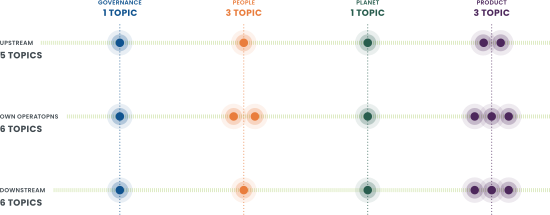
GOVERNANCE
Business Ethics, Transparency and Compliance
POSITIVE IMPACT
Compliance with ethical standards and regulations
Strengthening trust, integrity, and stakeholder confidence
Improved transparency and accountability through governance systems
NEGATIVE IMPACT
Limited visibility over indirect suppliers and third-party practices
PEOPLE
Human and Labor Rights
POSITIVE IMPACT
Promotion of ethical labor practices and human rights standards
Improved working conditions, employee well-being and engagement
NEGATIVE IMPACT
Risk of human rights violations in high-risk supply chains
PEOPLE
Customer Experience
POSITIVE IMPACT
Higher customer satisfaction, loyalty, and brand reputation
Stronger long-term partnerships through sustainability collaboration
NEGATIVE IMPACT
Loss of customers due to unmet expectations or poor communication
Misalignment with customer sustainability and regulatory expectations
PEOPLE
Occupational Health and Safety
POSITIVE IMPACT
Safe and healthy working environment for all employees
Reduced incident rates through preventive measures and training
Increased employee engagement and safety culture awareness
NEGATIVE IMPACT
Workplace accidents or exposure to unsafe conditions
Operational disruptions due to incidents or injuries
Legal and reputational risks from non-compliance with OHS standards
PLANET
Climate Action and Resilience
POSITIVE IMPACT
Reduction of GHG emissions through renewable energy, efficiency, and circular inputs
Increased resilience to climate-related risks across operations and supply chain
Contribution to low-carbon transition through sustainable product portfolio
NEGATIVE IMPACT
GHG emissions from virgin raw materials, production, and logistics
Exposure to physical climate risks (e.g., extreme weather, water stress)
Transition risks related to evolving climate regulations
PRODUCT
Product Design and Lifecycle Management
POSITIVE IMPACT
Reduced raw material consumption through eco-design and light weighting
Improved recyclability and design for circularity (aligned with PPWR)
Extension of product life through reuse, reconditioning (REBU) and durability
Increased use of recycled and certified materials
NEGATIVE IMPACT
Continued reliance on fossil fuel-based raw materials
High energy and water consumption in production processes
Use of chemicals with potential environmental or health impacts
Technical and infrastructure limitations for circular solutions
PRODUCT
Sustainable Products and Circularity
POSITIVE IMPACT
Enabling circular economy through recycled content and closed-loop systems
Reduced carbon footprint across the product lifecycle
Alignment with customer sustainability requirements and ESG criteria
Driving supply chain transformation through sustainable sourcing
NEGATIVE IMPACT
Limited availability of high-quality recycled materials
Cost volatility of sustainable raw materials
Risk of non-compliance with evolving regulations (e.g., PPWR)
Dependency on external recycling infrastructure
PRODUCT
Product Quality and Safety
POSITIVE IMPACT
High-quality, safe and compliant products (food / pharma standards)
Compliance with food contact and regulatory requirements
NEGATIVE IMPACT
Product recalls or non-compliance with safety regulations
Reputational and financial risks from quality failures
LEGAL DISCLAIMER
This Sustainability Report, reflecting FPS’ current sustainability initiatives and targets, has been developed based on information available at the time of preparation and is provided for informational purposes only as of the date of publication. This report contains statements regarding current expectations, objectives, plans, and future developments related to sustainability matters. Such statements are based on information, assumptions, and circumstances existing at the time of publication and may change over time due to evolving conditions and circumstances beyond the control of FPS. While FPS aims to present accurate and up-to-date information, no representation or warranty, express or implied, is made regarding the completeness, accuracy, or reliability of the information contained herein. Certain figures and data may be subject to rounding or future revision. Unless expressly stated otherwise, nothing in this report shall constitute a legally binding obligation, representation, warranty, or commitment by FPS. This report should be read together with FPS’ policies and applicable legal and regulatory requirements.