
Product Design and Lifecycle Management
Product Design and Lifecycle Management
We consider the entire product lifecycle, starting from raw material selection to end-of-life recovery, to create packaging solutions that are both technically reliable and resource-efficient.

At FPS, our approach to product design reflects a commitment to long-term environmental responsibility and functional performance.
We consider the entire product lifecycle, starting from raw material selection to end-of-life recovery, to create packaging solutions that are both technically reliable and resource-efficient. Our goal is to ensure that every design decision contributes to reducing waste, conserving energy and water, and enabling circularity.
Our packaging solutions are engineered to meet high-performance criteria while minimizing environmental footprint. Every product is designed with durability, and recyclability in mind.
Sourcing and material use decisions are guided by internal policies that prioritize environmental, and product safety considerations.
The use of recycled materials is carefully assessed for potential risks, durability, and long-term safety; any use of such materials is subject to strict compliance and quality controls. This approach enables FPS to deliver innovative, circular solutions without compromising on product integrity or regulatory alignment.

We use lifecycle assessment tools to measure the environmental performance of our products and production systems. These tools provide data-driven insights on emissions, resource use, and improvement opportunities, guiding product redesigns and material optimization.
Where appropriate, FPS also integrates materials derived from internal waste streams, such as Post-Industrial Recycled (PIR) content. These materials are incorporated into production when they meet internal quality thresholds and regulatory standards, contributing to our broader material efficiency and waste minimization goals.
In 2025, FPS consumed a total of 47,194 tons of raw materials. Of this, 4,205 tons, approximately 9%, consisted of recycled inputs:
3,337 tons
Post-Industrial Recycled (PIR) materials
867 tons
Post-Consumer Recycled (PCR) materials
These inputs are increasingly used across our product portfolio, particularly in applications that allow for substitution without compromising performance or safety.
Governance and Cross-Functional Ownership of Circularity
Our Vice President of Operations and Vice President UK & IR, Global 1Loop and Sustainability plays a key strategic role in driving circular economy initiatives and aligning sustainability priorities across all functions. Under this leadership, our manufacturing teams proactively seek out lower-impact material alternatives and support process optimizations that reduce resource consumption.
Product design and development teams, meanwhile, are responsible for integrating recyclability and material efficiency into packaging performance without compromising product quality and safety. These collaborative efforts ensure that environmental impact is considered from the design phase through to the product’s end of life.
We also work closely with our customers to promote sustainable packaging solutions, providing insights on the environmental benefits of recycled content and reusability.
Through this engagement, we help our partners align with global sustainability expectations while supporting our shared responsibility toward a more sustainable packaging ecosystem.
Actions and Initiatives
We are committed to actively supporting the global transition from linear to circular production systems through long-term investment in innovative technologies and process optimization.
Over the past three decades, we have implemented forward-looking programs designed to minimize environmental impacts while maximizing resource efficiency across our value chain.
Circularity is not limited to design, it also requires systems that ensure post-use recovery. FPS has developed a structured approach to recovering and reusing FIBCs through both reconditioning (REBU) and full recycling (Recycling Hub).
These systems allow used FIBCs to either return to circulation through REBU or be transformed into new products through the Recycling Hub, ensuring end-of-life materials are managed as valuable resources rather than waste.
FPS Recycling Hub End-to-End Recycling for Circular Impact
The FPS Recycling Hub in Romania is the largest and most advanced FIBC recycling facility in the world.
This purpose-built facility enables FPS to create a circular economy for Flexible Intermediate Bulk Containers (FIBCs) by converting used bags into high-quality recycled resin, which is then reintegrated into our production processes. An integrated 3-stage water treatment and recycling system is in place to support the environmental efficiency of the operation.
Water used in the washing process is treated and reused internally, significantly reducing the facility’s overall water footprint.
Our recycling process follows a robust and quality-assured workflow that includes:
Collection and Sorting
Used FIBCs are collected from various industrial users and sorted based on polymer composition, color, contamination level, and usage history. This first stage ensures consistent material feedstock quality for downstream processing.
Shredding and Intensive Washing
Sorted bags are mechanically shredded and undergo a multi-stage water-based cleaning process using industrial washers. This removes dust, adhesives, printing residues, and other contaminants while maximizing the recovery of usable polymer.
Water Treatment and Reuse
A proprietary three-stage water treatment system filters, clarifies, and recycles wash water, significantly reducing freshwater consumption and environmental discharge. Water is reused multiple times within the facility, supporting FPS’s broader water stewardship goals.
Extrusion and Pelletizing
Cleaned flakes are dried and melted through advanced extruders, forming high-purity recycled pellets (regranulate). These pellets are quality-tested and stored under traceable conditions for reuse in producing new FIBCs, including our FlexiGreen bags.
Traceability and Certification
All batches are recorded, tested, and labeled according to strict quality assurance protocols to ensure traceability and compliance with regulatory and customer requirements.
Our recycling approach is aligned with evolving regulatory frameworks such as the EU Packaging and Packaging Waste Regulation (PPWR).
By reintegrating post-use FIBCs into our production loop, the Recycling Hub supports FPS’s long-term goals of reducing virgin plastic consumption and landfill dependency. Based on internal analysis, each FIBC produced with 30% recycled content reduces CO2 emissions on average 15%, helping our customers meet both carbon and virgin material usage reduction targets.
For more detailed information about the Recycling Hub, please refer to the FPS Recycling Hub Brochure.
Our recycling approach is aligned with evolving regulatory frameworks such as the EU Packaging and Packaging Waste Regulation (PPWR), supporting requirements related to recyclability, reuse, and the increased use of post-consumer recycled (PCR) content. This enables FPS to deliver both environmental and economic value to customers, choosing FlexiGreen, while supporting their compliance with current and future regulatory expectations.
In recognition of its robust systems and traceability practices, the facility has obtained the RecyClass Recycling Process and Traceability Certifications, verifying compliance with the EN 15343:2007 standard.
We have established measurable product recycling targets that scale with our capacity and customer adoption:
Recovered Plastics from the Market for Recycling (tons)
The Recycling Hub also complements our REBU reconditioning program, offering a flexible system where used FIBCs can either be cleaned and reused or fully recycled, depending on their condition and customer requirements. This integration of reuse and recycling enables FPS to deliver customized, scalable, and circular packaging solutions across a variety of industrial sectors while simultaneously reducing pressure on natural resources such as water and fossil-based polymers.
How the circular economy of FIBCs works
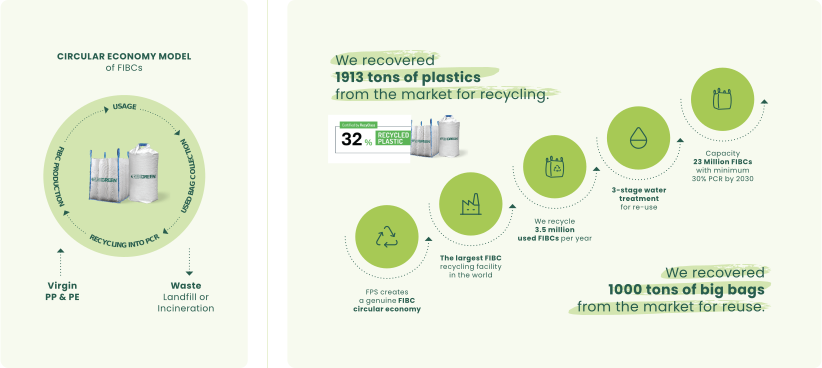
We reached our target of recovering 240,000 bags ahead of schedule in 2025. This milestone reflects the continued expansion of our reconditioning activities and strong customer engagement. Going forward, we will focus on increasing the share of reconditioned FIBCs reintroduced to the market for reuse, further strengthening the circularity of our products.
REBU – Reconditioning Process for Multi-Trip FIBCs
As part of our commitment to product longevity and material efficiency, FPS has developed and expanded its REBU reconditioning program. The REBU process is a structured system designed to enable the reuse of emptied FIBCs that are suitable for multi-trip applications. This process involves the collection, visual and physical inspection, professional cleaning, drying, and preparation of bags for reuse in line with customer specifications and regulatory requirements. Each step is conducted under strict quality assurance protocols to ensure the technical integrity and cleanliness of the reconditioned bags. Bags are tracked by lot and traceability is maintained throughout the reconditioning cycle.
REBU Process
REBU is our FIBC reconditioning operation, working in close alignment with our Recycling Hub to support circularity across our value chain.

1 Storage of Emptied FIBCs
2 Collection by REBU
3 Cleaning & Inspection of FIBCs
4 Reuse at the Filling Point
5 Emptying FIBCs
The REBU program contributes directly to reducing the consumption of virgin raw materials and preventing used bags from ending up in landfill or incineration. Instead, it extends the lifecycle of products already in circulation. The program operates with scaling targets:
80,000 bags
reconditioned in 2024.
243,780 bags
reconditioned in 2025.
Reconditioning is offered to customers in multiple regions and is supported by trained operators, automated washing systems, and dedicated logistics channels that ensure safe and efficient handling of used bags.
REBU not only supports FPS’s waste reduction goals but also provides a cost-effective and sustainable alternative for our customers.

Global Recognition for FPS Circularity Hub
FPS has been awarded the “Best Sustainability Initiative Award 2025” by the UN Global Compact Network Netherlands for its Circularity Hub in Romania, recognizing a breakthrough approach to circularity in industrial packaging.
Announced at the Leaders of Progress Summit, attended by over 500 global leaders including key customers and stakeholders, this award represents one of the most prestigious sustainability recognitions in the Netherlands. It highlights how FPS’s commitment to innovation, collaboration, and purpose-driven action is creating tangible impact at scale. The Circularity Hub in Romania is the world’s first large-scale circular system for FIBCs, designed to address critical environmental challenges in the packaging industry. Through advanced reconditioning and recycling processes, the Hub extends the life of used FIBCs and significantly reduces plastic waste. Beyond operational performance, the initiative demonstrates how circular business models can be scaled to deliver measurable environmental benefits while supporting customer needs and regulatory expectations. The Circularity Hub directly contributes to multiple UN Sustainable Development Goals, including SDG 12 (Responsible Consumption and Production), SDG 13 (Climate Action), SDG 6 (Clean Water and Sanitation), and SDG 17 (Partnerships for the Goals). This recognition reflects the collective effort of FPS teams and partners across the value chain and reinforces our ambition to lead the transition toward a more circular, resource-efficient, and low-impact packaging industry.
LEGAL DISCLAIMER
This Sustainability Report, reflecting FPS’ current sustainability initiatives and targets, has been developed based on information available at the time of preparation and is provided for informational purposes only as of the date of publication. This report contains statements regarding current expectations, objectives, plans, and future developments related to sustainability matters. Such statements are based on information, assumptions, and circumstances existing at the time of publication and may change over time due to evolving conditions and circumstances beyond the control of FPS. While FPS aims to present accurate and up-to-date information, no representation or warranty, express or implied, is made regarding the completeness, accuracy, or reliability of the information contained herein. Certain figures and data may be subject to rounding or future revision. Unless expressly stated otherwise, nothing in this report shall constitute a legally binding obligation, representation, warranty, or commitment by FPS. This report should be read together with FPS’ policies and applicable legal and regulatory requirements.