
Double Materiality Assessment
Double Materiality Assessment
Throughout the assessment, FPS engaged with 187 individual inputs.
We updated our materiality assessment to align with the latest requirements and to future-proof our strategic sustainability priorities. A Double Materiality (when used as a concept title) assessment has been carried out by considering the guidelines of European Sustainability Reporting Standards (ESRS).
This approach helps to understand both how sustainability issues may affect FPS, and how FPS’s activities impact the environment, society, and the economy.
It provides a balanced view of risks, opportunities, and impacts, supporting more transparent and accountable decision-making.

Methodology
In the initial phase of the double materiality assessment, we compiled a long list of 24 sustainability topics.
This was based on a review of sector-specific and global sustainability trends, key reporting frameworks such as ESRS, SASB; ESG rating criteria including S&P and MSCI; as well as peer company practices. This process integrated relevant regulatory requirements and industry benchmarks. The resulting list served as the basis for our materiality assessment.
Stakeholder Engagement and Prioritization
To validate and refine the long list, surveys, and interviews were conducted with internal and external stakeholders to gather insights into which topics are perceived as most significant from both impact and financial materiality perspectives. Throughout the assessment, FPS engaged with five key stakeholder groups: FPS Board, FPS Leadership Team, colleagues, suppliers, customers, consultants & partners including international organizations & initiatives. In total, 187 individual inputs were collected.
Executive-Level Strategic Insights
To further assess business relevance, we conducted face-to-face and virtual interviews with six members of the Leadership and Sustainability Leadership Teams. These discussions explored the impact of each topic on FPS’s strategic objectives, long-term risks and opportunities, and value creation. These perspectives provided critical input to align material issues with FPS’s strategic priorities.
External Trend Analysis & Benchmarking
To further strengthen the assessment, internationally recognized references such as the European Sustainability Reporting Standards (ESRS), the World Economic Forum Global Risks Report (WEF), MSCI and S&P Global Corporate Sustainability Assessments (CSA), the Sustainability Accounting Standards Board (SASB), and the European Green Deal were reviewed. This helped us identify strategic opportunities and evaluate our position in the industry.
Impact Assessment
Each topic was assessed by integrating stakeholder perceptions with FPS’s internal evaluations. We applied a structured lens to understand the scale, scope, severity, and likelihood of potential impacts. Both positive and negative implications were considered, ensuring a balanced and comprehensive view of FPS’s social, environmental, and economic impact.
Risk & Opportunity Assessment
Using input from executive interviews and global references, we mapped each material topic against potential risks and opportunities for FPS. We analyzed how these topics could affect FPS’s operations, reputation, and long-term financial performance. This analysis supported more informed decision-making and resource allocation across the organization.

Results
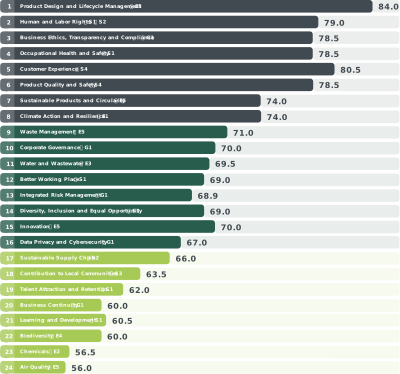
Feedback gathered from FPS’s stakeholders revealed a strong alignment across groups regarding key sustainability priorities. “Customer Experience” and “Product Quality and Safety” emerged as top-priority topics for all stakeholder groups, reflecting FPS’s critical role in delivering reliable and safe packaging solutions.
Additionally, “Human and Labor Rights” and “Product Design and Lifecycle Management” were consistently highlighted as highly material across stakeholders, underscoring growing expectations around ethical value chains and the integration of circularity principles into packaging solutions.
From the perspective of FPS’s executive team, governance-related topics were considered highly material, indicating a strong internal focus on transparent, accountable, and ethical business conduct.
Executives also emphasized innovation areas such as low-carbon product development, material optimization, and process improvements as strategic priorities.
These efforts are primarily driven by evolving customer expectations and regulatory requirements, both of which FPS actively monitors and responds to, through proactive measures and continuous improvement initiatives.
As a result of the analysis, eight topics were grouped as very high priority, eight as high priority, and the remaining eight as medium priority.
As a result of the analysis, eight topics were grouped as very high priority, eight as high priority, and the remaining eight as medium priority.
Double Materiality Matrix
Upstream
Own Operations
Downstream
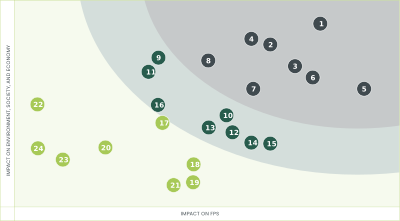
8
Very High Priority
8
High Priority
8
Medium Priority
Material Topic Impact Scores
LEGAL DISCLAIMER
This Sustainability Report, reflecting FPS’ current sustainability initiatives and targets, has been developed based on information available at the time of preparation and is provided for informational purposes only as of the date of publication. This report contains statements regarding current expectations, objectives, plans, and future developments related to sustainability matters. Such statements are based on information, assumptions, and circumstances existing at the time of publication and may change over time due to evolving conditions and circumstances beyond the control of FPS. While FPS aims to present accurate and up-to-date information, no representation or warranty, express or implied, is made regarding the completeness, accuracy, or reliability of the information contained herein. Certain figures and data may be subject to rounding or future revision. Unless expressly stated otherwise, nothing in this report shall constitute a legally binding obligation, representation, warranty, or commitment by FPS. This report should be read together with FPS’ policies and applicable legal and regulatory requirements.